Research Area
CI Engine
The CI engine generates heat from compression together with the injection of fuel without needing any spark. This contrasts with spark-ignition engines.
CI engine has a comprehensive phenomenon based on turbulent nonpremixed flame. Conventional combustion model is not accurate because it has an unconditional averaging. Therefore, we are using the conditional averaging model. This is a Conditional Moment Closure(CMC) model. Now we are simulating various engines using the CMC model. This model shows more accurate results.
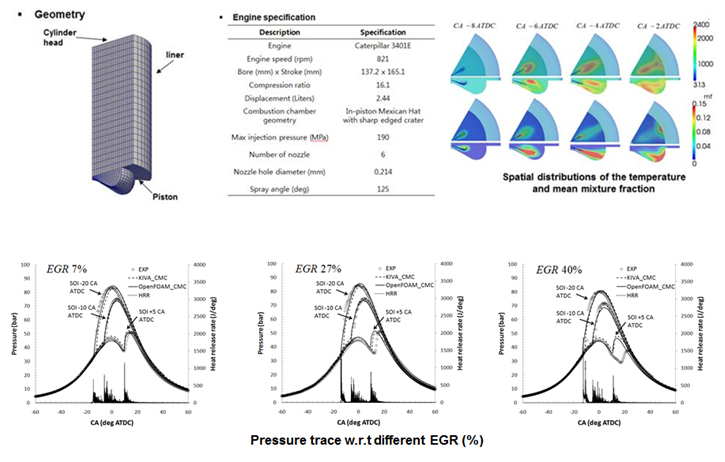
Results about simulating CI engine using OpenFOAM and KIVA
However, The CMC model has an expansive computational cost. So, we are developing a simplified CMC model.

Idea of Simplified CMC
SI Engine
The term spark-ignition engine refers to internal combustion engines, generally gasoline engines, where the combustion process of the air-fuel mixture is ignited by a spark from a spark plug. This is in contrast to compression-ignition engines.
SI engine is based on a turbulent premixed flame. The turbulent premixed flame has a characteristic which propagate from a burned region to an unburned region. When flame is propagating, the turbulent burning velocity, , is a critical parameter. The turbulent burning velocity decides efficiency of the SI engine. Therefore, it is important that we get an accurate turbulent burning velocity.
We derive a formulation of turbulent burning velocity through a DNS(Direct Numerical Simulation). This formulation is inserted to OpenFOAM code. Next, we will simulate the SI engine using this code.
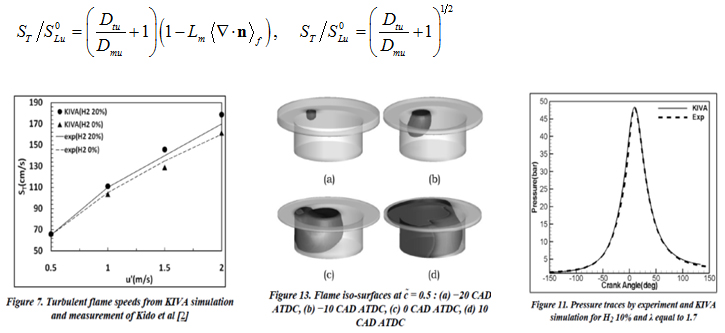
Results of the SI engine using the KIVA
CMC(Conditional Moment Closure) Model
CMC model is the turbulent nonpremixed flame model. Conventional unconditional averaging model is not accurate because it cannot totally describe fluctuation of turbulence. But the CMC model is more accurate than conventional model. That’s because it uses a conditional averaging using a parameter, mixture fraction. We can get more accurate results by using a flame structure and beta-PDF.
